Hi everyone! My name is Lily and I am from Redwood City, California. I am majoring in Operations Research and Financial Engineering, and I’m also super excited to be a part of Service Focus in the fall!
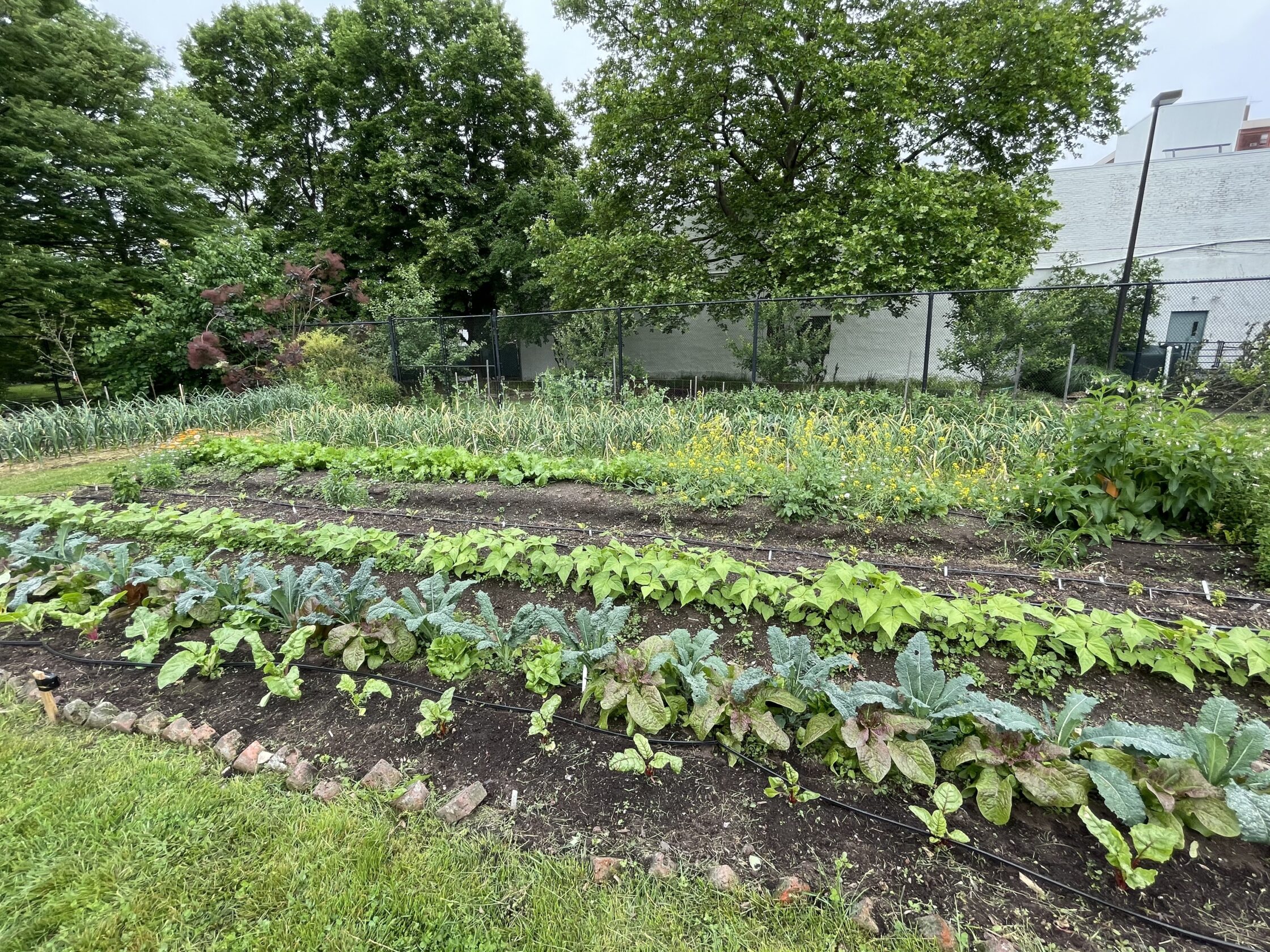
This summer, I worked as an intern for The Farm Project with Professor Rubenstein and Gina Talt. The goal of the project is to compare organic and regenerative agriculture practices (i.e. no-till practices, crop rotations, companion planting, etc.) across farms in the Princeton area in order to determine which are the best methods. My internship was of a hybrid format – I got to spend 2-3 days each week doing field work and the rest of my time was spent on data entry and analysis.

At each of the farms, we set up Arable sensors in the crop beds that we were most concerned with studying. The sensors (shown in the picture above) collected real-time data of various plant health and environmental indicators. The key plant health indicator that we tracked was the normalized difference vegetation index, or NDVI. In order to track this, the Arable sensor has a spectrometer that measures how much red light is absorbed and infrared light is reflected by the plant below. These measurements are then plugged into a formula to calculate NDVI. Besides NDVI, the Arable sensor also tracks other indicators such as evapotranspiration (ETc), sunlight radiation (SWdw), leaf wetness, precipitation, and more.
Besides the data collected by the sensors, we also took weekly crop measurements, set insect traps, measured soil health, and monitored tomato disease levels. The farmers also filled out weekly questionnaires so that we could track the use of inputs (such as fertilizers, fungicides, etc.), weeding, and other practices.
While I wasn’t spending time on the farms doing field work, I was doing data tracking and analysis. I organized and prepared spreadsheets with the data that we had collected, and I also closely analyzed crop performance using JMP over the course of the summer to figure out which organic farming techniques were the most effective.
Looking back at my work from this summer, not only did I have the opportunity to practice technical data manipulation and analysis skills, but I also learned a lot about regenerative agriculture practices and the issues faced by farmers today. Farmers play an incredibly important role in our society, but they are increasingly affected by climate change and other issues. Regenerative agriculture practices such as interplanting (as opposed to monoculture) and crop rotations can help us uncover ways to increase the resilience of plants as they face more difficult environments to grow in. It is important to the health of our society that we find ways to make farming more sustainable and resilient enough to withstand our changing climate.